本期为大家推荐的内容为论文Experimental and numerical investigation of an efficient oxygen supply device for improving the sleep environment at high altitudes《用于改善高海拔睡眠环境的高效附面式供氧装置的实验与数值模拟研究》,发表在 Building and Environment期刊,欢迎讨论交流。
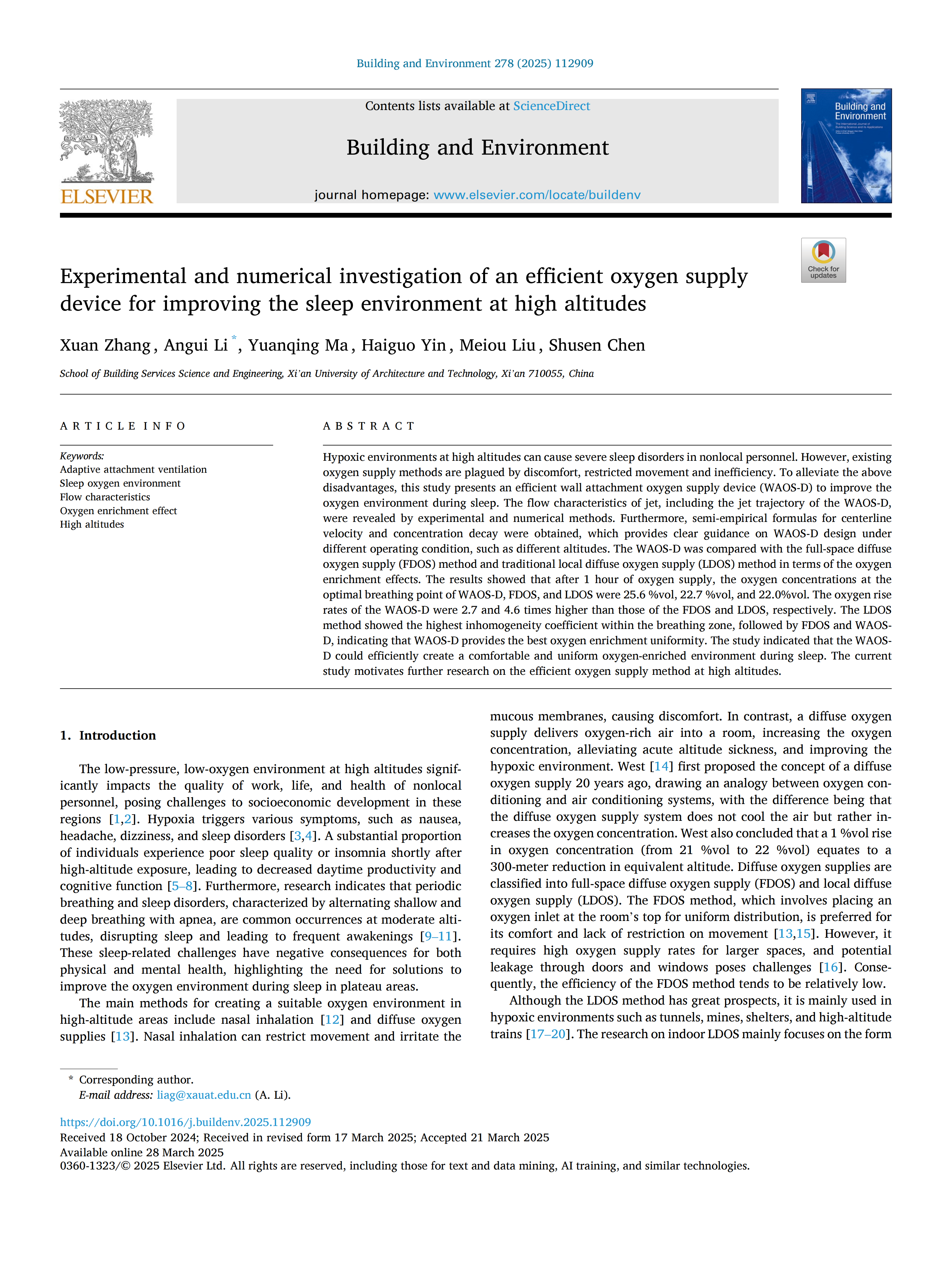
高海拔低氧环境易导致外来人员出现严重睡眠障碍,而现有供氧方式存在不适感、活动受限及效率低下等问题。为此,本研究提出一种高效附面式供氧装置(WAOS-D),用于改善睡眠期间的氧环境。通过实验与数值模拟方法,揭示了WAOS-D的射流特性与轨迹特征,并建立了射流轴线速度与浓度衰减的半经验公式,为不同海拔等工况下的装置设计提供了明确依据。通过对比WAOS-D与全空间弥散供氧(FDOS)及传统局部弥散供氧(LDOS)的富氧效果,发现供氧1小时后三者呼吸区采样点氧浓度体积分数分别为25.6%、22.7%与22.0%;WAOS-D的氧浓度提升速率分别是FDOS和LDOS的2.7倍与4.6倍。呼吸区内不均匀系数表现为LDOS最高,FDOS次之,WAOS-D最低,表明WAOS-D具有最优的氧分布均匀性。研究表明,WAOS-D能够高效营造舒适均匀的睡眠富氧环境。本研究为高海拔高效供氧技术的进一步发展提供了重要参考。
文章题目:Experimental and numerical investigation of an efficient oxygen supply device for improving the sleep environment at high altitudes《用于改善高海拔睡眠环境的高效附面式供氧装置的实验与数值模拟研究》
文章作者:Xuan Zhang, Angui Li*, Yuanqing Ma, Haiguo Yin, Meiou Liu, Shusen Chen
发表刊物:Building and Environment(Volume 278)
DOI检索:https://doi.org/10.1016/j.buildenv.2025.112909
ABSTRACT
Hypoxic environments at high altitudes can cause severe sleep disorders in nonlocal personnel. However, existing oxygen supply methods are plagued by discomfort, restricted movement and inefficiency. To alleviate the above disadvantages, this study presents an efficient wall attachment oxygen supply device (WAOS-D) to improve the oxygen environment during sleep. The flow characteristics of jet, including the jet trajectory of the WAOS-D, were revealed by experimental and numerical methods. Furthermore, semi-empirical formulas for centerline velocity and concentration decay were obtained, which provides clear guidance on WAOS-D design under different operating condition, such as different altitudes. The WAOS-D was compared with the full-space diffuse oxygen supply (FDOS) method and traditional local diffuse oxygen supply (LDOS) method in terms of the oxygen enrichment effects. The results showed that after 1 hour of oxygen supply, the oxygen concentrations at the optimal breathing point of WAOS-D, FDOS, and LDOS were 25.6 %vol, 22.7 %vol, and 22.0%vol. The oxygen rise rates of the WAOS-D were 2.7 and 4.6 times higher than those of the FDOS and LDOS, respectively. The LDOS method showed the highest inhomogeneity coefficient within the breathing zone, followed by FDOS and WAOSD, indicating that WAOS-D provides the best oxygen enrichment uniformity. The study indicated that the WAOSD could efficiently create a comfortable and uniform oxygen-enriched environment during sleep. The current study motivates further research on the efficient oxygen supply method at high altitudes.
论文原文下载见附件  EXPERI~1.pdf