本期为大家推荐的内容为论文Thermal pressure ventilation analysis in a sloping high-temperature tunnel: A case study in China《高地温倾斜隧道热压通风分析:以中国某隧道为例》,发表在Tunnelling and Underground Space Technology期刊,欢迎讨论交流。
隧道热害问题日益凸显,深埋式隧道更是如此。在倾斜高温隧道中,热压通风技术不可忽视。合理的热压通风方案可实现机械通风系统的节能降耗,具有重要的工程实践意义。为此,本研究提出了一种计算模型,将围岩温度的解析解与气流温度的离散解相结合,最大相对预测误差为6.9%。基于所建模型,开展了通风时间、环境温度、隧道坡度及隧道表面粗糙度对热压通风动态特性的参数敏感性分析,并完成了热压通风技术的节能潜力评估。研究发现,热压通风效应与通风时间、环境温度呈负相关关系,而与隧道坡度呈正相关关系。隧道表面粗糙度对热压通风效应的影响幅度相对有限。以坡度为2%的尼日高温隧道为例,经过407天的持续热压通风,隧道内气流温度可有效降至28℃以满足冷却需求。此外,节能效益分析表明,该隧道采用热压通风技术后,首年可节省275兆瓦时机械通风电能,减少23.0吨碳排放,经济与环境效益显著。本研究不仅为热压通风计算提供了一种新计算模型,也为高温倾斜巷道热压通风系统的设计与优化提供了理论支撑。
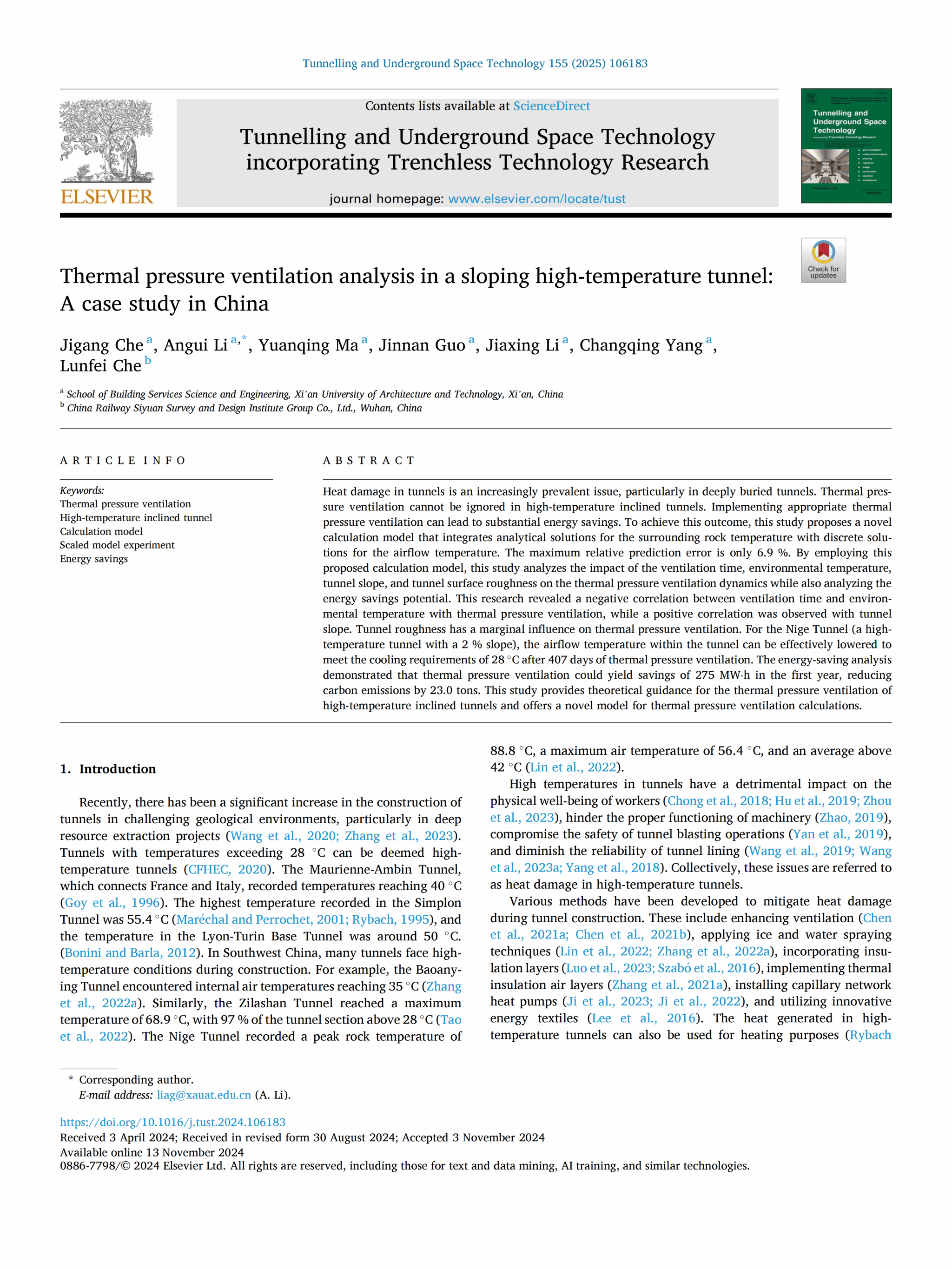
题目:Thermal pressure ventilation analysis in a sloping high-temperature tunnel:A case study in China(高地温倾斜隧道热压通风分析:以中国某隧道为例)
作者:Jigang Che, Angui Li,*, Yuanqing Ma, Jinnan Guo, Jiaxing L, Changqing Yang, Lunfei Che
发表刊物:Tunnelling and Underground Space Technology (Volume 155)
DOI:https://doi.org/10.1016/j.tust.2024.106183
ABSTRACT
Heat damage in tunnels is an increasingly prevalent issue, particularly in deeply buried tunnels. Thermal pressure ventilation cannot be ignored in high-temperature inclined tunnels. Implementing appropriate thermal pressure ventilation can lead to substantial energy savings. To achieve this outcome, this study proposes a novel calculation model that integrates analytical solutions for the surrounding rock temperature with discrete solutions for the airflow temperature. The maximum relative prediction error is only 6.9 %. By employing this proposed calculation model, this study analyzes the impact of the ventilation time, environmental temperature, tunnel slope, and tunnel surface roughness on the thermal pressure ventilation dynamics while also analyzing the energy savings potential. This research revealed a negative correlation between ventilation time and environmental temperature with thermal pressure ventilation, while a positive correlation was observed with tunnel slope. Tunnel roughness has a marginal influence on thermal pressure ventilation. For the Nige Tunnel (a hightemperature tunnel with a 2 % slope), the airflow temperature within the tunnel can be effectively lowered to meet the cooling requirements of 28 ◦C after 407 days of thermal pressure ventilation. The energy-saving analysis demonstrated that thermal pressure ventilation could yield savings of 275 MW⋅h in the first year, reducing carbon emissions by 23.0 tons. This study provides theoretical guidance for the thermal pressure ventilation of high-temperature inclined tunnels and offers a novel model for thermal pressure ventilation calculations.
论文原文下载见附件  高地温倾斜隧道热压通风分析:以中国某隧道为例.pdf