本期为大家推荐的内容为论文A two-level turbulent density-based topology optimization method: A low-resistance U-bend channel flow《一种两级湍流密度型拓扑优化方法:低流阻U型弯管设计》,发表在Building and Environment期刊,欢迎讨论交流。
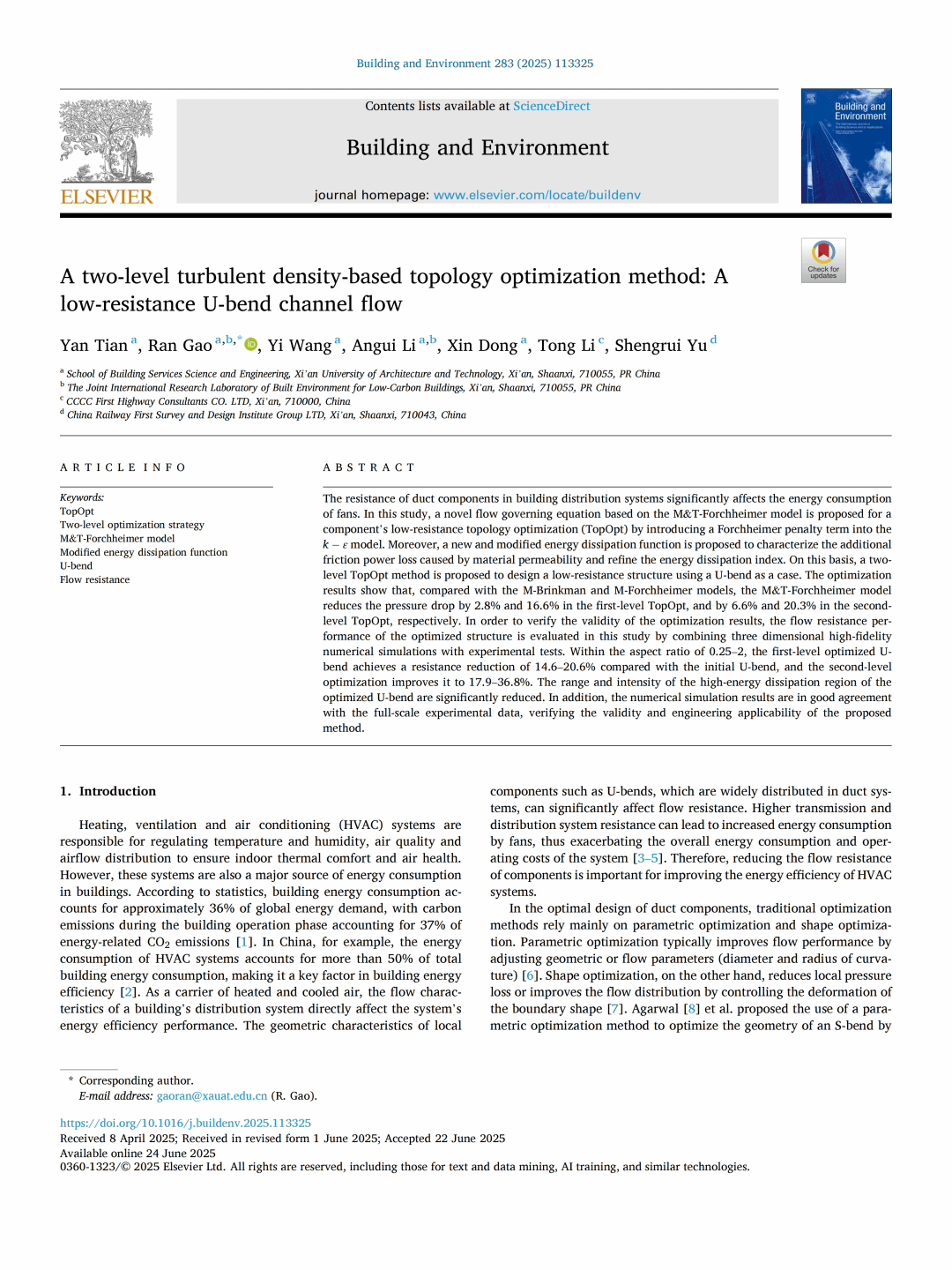
建筑输配系统中管道构件的阻力对风机能耗具有显著影响。本研究提出了基于M&T-Fchheimer模型的流动控制方程,通过k-ε模型中引入Forchheimer项,来实现组件的低阻力拓扑优化。同时,提出了修正的能量耗散函数,以表征材料渗透性引起的额外摩擦功率损失,完善了能量耗散指标。基于此,提出了一种基于初始形状的两级拓扑优化方法,以U型弯管为例设计出了低阻力结构。优化结果表明:相比于与M-Brinkman模型和M-Forchheimer模型,M&T-Forchheimer模型在两级优化中分别降低阻力值为2.8%、16.6%和6.6%、20.3%。为验证优化结果的有效性,本文结合三维数值模拟与实验测试对优化结构的流动阻力性能进行了评估。在宽高比为0.25~2范围内,一级优化的U型弯管相较于原U型弯管减阻率达到14.6%~20.6%,二级优化提升至17.9%~36.8%。优化的U型弯管的高能量耗散区域范围和强度明显降低。数值模拟结果与全尺寸实验数据吻合,验证了所提方法的有效性。
题目:A two-level turbulent density-based topology optimization method: A low-resistance U-bend channel ffow(一种两级湍流密度型拓扑优化方法:低流阻U型弯管设计)
作者:Yan Tian, Ran Gao* , Yi Wang, Angui Li, Xin Dong, Tong Li, Shengrui Yu
发表刊物:Building and Environment(Volume 283)
DOI:https://doi.org/10.1016/j.buildenv.2025.113325
ABSTRACT
The resistance of duct components in building distribution systems signiffcantly affects the energy consumption of fans. In this study, a novel ffow governing equation based on the M&T-Forchheimer model is proposed for a component’s low-resistance topology optimization (TopOpt) by introducing a Forchheimer penalty term into the k − ε model. Moreover, a new and modiffed energy dissipation function is proposed to characterize the additional friction power loss caused by material permeability and reffne the energy dissipation index. On this basis, a twolevel TopOpt method is proposed to design a low-resistance structure using a U-bend as a case. The optimization results show that, compared with the M-Brinkman and M-Forchheimer models, the M&T-Forchheimer model reduces the pressure drop by 2.8% and 16.6% in the ffrst-level TopOpt, and by 6.6% and 20.3% in the secondlevel TopOpt, respectively. In order to verify the validity of the optimization results, the ffow resistance performance of the optimized structure is evaluated in this study by combining three dimensional high-ffdelity numerical simulations with experimental tests. Within the aspect ratio of 0.25–2, the ffrst-level optimized Ubend achieves a resistance reduction of 14.6–20.6% compared with the initial U-bend, and the second-level optimization improves it to 17.9–36.8%. The range and intensity of the high-energy dissipation region of the optimized U-bend are signiffcantly reduced. In addition, the numerical simulation results are in good agreement with the full-scale experimental data, verifying the validity and engineering applicability of the proposed method.
论文原文下载见附件  一种两级湍流密度型拓扑优化方法:低流阻U型弯管设计.pdf