本期为大家推荐的内容为论文A low resistance circular diverter tee based on an improved random forest model《基于改进随机森林模型的低阻力圆形分流三通》,发表在Scientific Reports期刊,欢迎讨论交流。
局部构件在建筑输配系统中应用广泛,其阻力会显著增加系统的运行能耗。本文以三通构件为研究对象,提出了一种基于改进随机森林模型的建筑输配系统阻力优化新方法。不同于现有研究中依赖反复试错经验法的局部构件减阻方案,本研究引入一种后验优化方法,可在设定范围内求解全局最优解。研究首先对三通构件的最优形态进行预测,随后通过实验与数值模拟验证其减阻效果。结果表明,在不同工况下,经优化的三通构件可使主管路减阻率达到28%~66%,支管路减阻率达到16%~93%。以往的减阻研究多聚焦于可简化为二维模型的矩形构件,而本研究针对圆形构件提出了后验减阻方法,可为建筑输配系统的减阻设计提供参考。
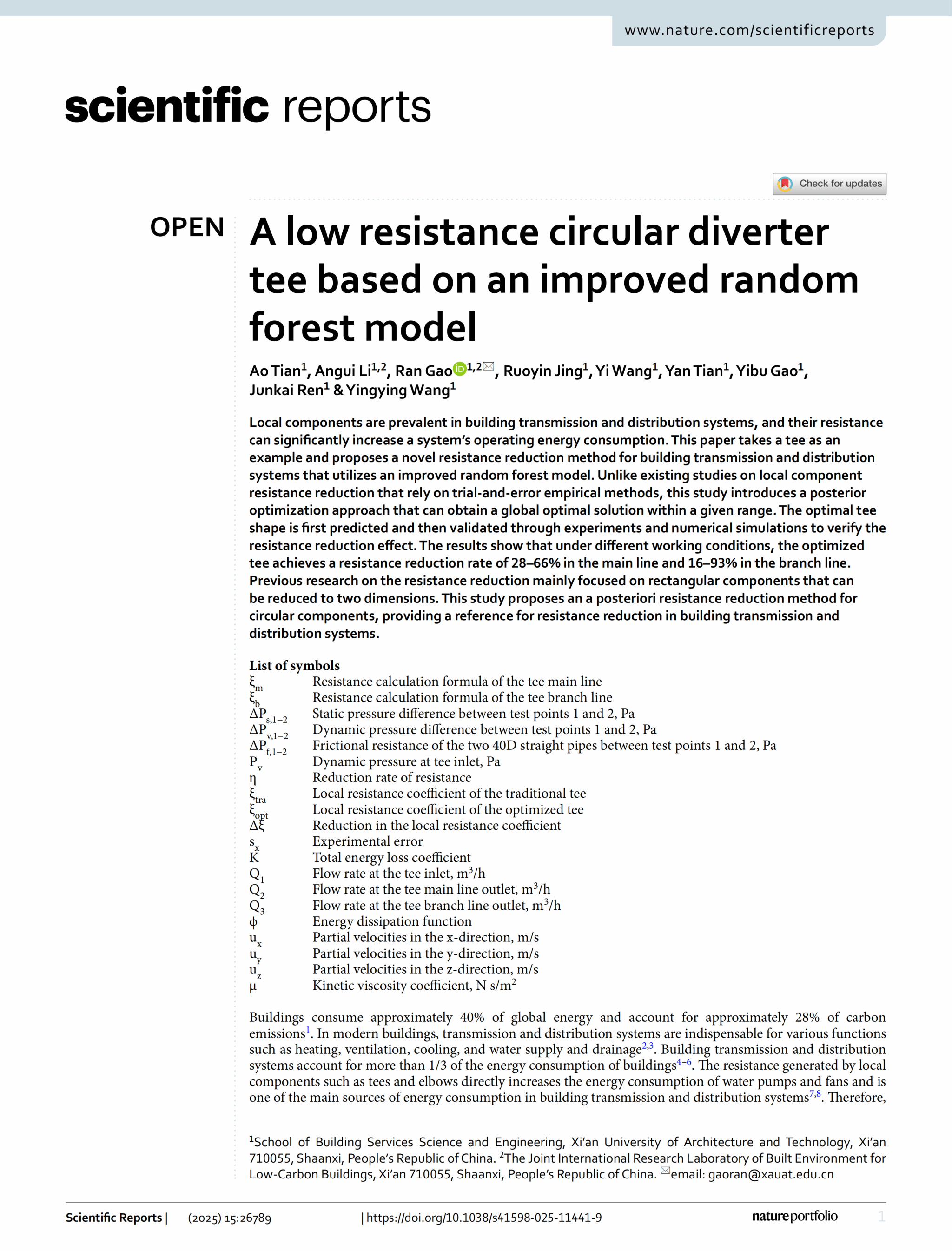
题目:A low resistance circular diverter tee based on an improved random forest model(基于改进随机森林模型的低阻力圆形分流三通)
作者:Ao Tian, Angui Li, Ran Gao, Ruoyin Jing, Yi Wang, Yan Tian, Yibu Gao, Junkai Ren & Yingying Wang
发表刊物:Scientific Reports (Volume 15)
DOI:https://doi.org/10.1038/s41598-025-11441-9
ABSTRACT
Local components are prevalent in building transmission and distribution systems, and their resistance can significantly increase a system’s operating energy consumption. This paper takes a tee as an example and proposes a novel resistance reduction method for building transmission and distribution systems that utilizes an improved random forest model. Unlike existing studies on local component resistance reduction that rely on trial-and-error empirical methods, this study introduces a posterior optimization approach that can obtain a global optimal solution within a given range. The optimal tee shape is first predicted and then validated through experiments and numerical simulations to verify the resistance reduction effect. The results show that under different working conditions, the optimized tee achieves a resistance reduction rate of 28-66% in the main line and 16-93% in the branch line. Previous research on the resistance reduction mainly focused on rectangular components that can be reduced to two dimensions. This study proposes an a posteriori resistance reduction method for circular components, providing a reference for resistance reduction in building transmission and distribution systems.
论文原文下载见附件  PSEP-S-26-00293.pdf